Showing posts with label Jewish-Christian Relations. Show all posts

Thursday, April 10, 2025

Book Review: Ehyeh: A Kabbalah For Tomorrow


Ehyeh: A Kabbalah For Tomorrow

Author: Arthur Green

Publisher: Jewish Lights Publishing, paperback, 192 pages, including Preface, Introduction, Epilogue, and Notes

Reviewed by Rev. Garth Wehrfritz-Hanson

The Author 

At the time of publication, Dr. Arthur Green was Philip W. Lown Professor of Jewish Thought at Brandeis University and dean of the Rabbinical School at Boston’s Hebrew College. Former president of the Reconstructionist Rabbinical College, he is also a rabbi, a historian of Jewish mysticism, and a theologian. He is the author of: These Are the Words: A Vocabulary of Jewish Spiritual Life; Tormented Master: The Life and Spiritual Quest of Rabbi Nahman of Bratslav; Seek My Face: A Jewish Mystical Theology; and The Language of Truth: Teaching from the Sefat Emet. He is also co-editor of Your Word Is Fire: The Hasidic Masters on Contemplative Prayer. 

Contents

The volume contains the following: Confession, By Way of a Preface, Introduction: Ehyeh As a Name of God, Part I: Rereading The Old Tradition—consisting of 6 chapters, Part II: Looking Toward Tomorrow—consisting of 6 chapters, Epilogue: To Keep on Learning—Where Do I Go from Here? and Notes. 

Brief Observations 

Rabbi Dr. Arthur Green displays his erudite gifts and skills in this volume. At the time this volume was published, he had studied Kabbalah and Jewish mysticism for 40 years. He is likely one of the most highly respected experts on Jewish mysticism. Yet, he humbly states: “I have not yet come up with any definitive answers” (p. xvi). 

As I read this work, I realized how in-depth Professor Green takes his audience. One of the main reasons he wrote this book was for seekers—both Jewish and non-Jewish, and he states that he still considers himself to be a seeker. He invites them to take their time reading, and engage with him both heart and mind. 

In his introduction, Rabbi Dr. Green begins with the Kabbalah hidden name of God Ehyeh(pronounced eh-yeh), “I shall be.” He suggests that: “The name Y-H-W-H should not be translated “God” or “Lord,” but rather “Is-Was-Will Be” (p. 2). God’s name is more verb than noun. He also explains the kabbalist word keter: “Keter is existence that precedes all definition” (p. 5). 

In “1 Kabbalah Old and New,” Professor Green states the meaning of the word kabbalah, “the received.” Traditions received from previous generations. 

In “2 There Is Only One,” Rabbi Dr. Green addresses The One and the many, emphasizing the oneness of all that exists: “Kabbalah teaches that there is a secret unity of all Being, hidden within the multiplicity and diversity of life as we experience it” (p. 20). It was God’s love that created everyone and everything.

In “3 Torah: Creation’s Truth Revealed,” Professor Green refers to a primordial Torah, Torah revealed to Moses on Mount Sinai, and a new Torah created from life experiences.

In “4 Sefirot: The One and the Ten,” Rabbi Dr. Green explains the Ten Sefirot, with the aid of diagrams. He also includes “A Guided Meditation.” 

Throughout this volume, Professor Green explains a variety of Hebrew words and letters, and their significance. In one section he includes “A Meditation On God’s Name,” (p. 82f). 

In “7 Seeking a Path,” Rabbi Dr. Green states that: “Mystics share with other religious people an intense awareness of Divine Presence and a constant readiness to respond to that presence in both prayer and action” (p. 96). In this chapter, he also includes: “These Are the Things a Person Should Do to Live by Them,” (p. 102f) listing 14 things to practice one’s faith.

In “8 Great Chain of Being: Kabbalah for an Environmental Age,” the author acknowledges the tragic state of creation and humankind, stating: “The changes needed in collective human behavior in order to save us from self-destruction are stupendous” (p. 118). 

In “10 What about Evil?” Professor Green includes a discussion on the biblical stories of Adam and Eve and Cain and Abel, as well as the Holocaust, and the conflict between Israelis and Palestinians. He believes that: “To be a Jew is to think about evil. The fact that we have so long been its victims does not mean that we are never its perpetrators” (p. 138). 

In “11 The Life of Prayer,” Rabbi Dr. Green identifies two traditional categories of prayer—spontaneous and liturgical. He also explains a diagram of “The Kabbalistic ‘Amidah” (pp. 160-165). 

In “12 Community: Where Shekhinah Dwells,” the author points out that the 613 commandments are rooted in the original 10 commandments. He also underscores the importance of creativity in order to teach Torah: “The mystical tradition has always been especially open to innovative, sometimes even wildly radical new readings of Torah” (p. 174). 

In “Epilogue: To Keep on Learning—Where Do I Go from Here?” Professor Green mentions several scholars, and recommends some their works. He starts with two of his teacher’s works, Abraham Joshua Heschel: God in Search of Man, and The Sabbath. He also recommends that it is better to learn Hebrew and read sources in that language, than to rely on English translations—something is lost in translation. 

This volume will be very beneficial to both Jewish and Christian scholars, students, and clergy interested in Kabbalah. As a Christian reviewer, I especially appreciated, and was reminded of parallels in Christianity, of the list of 14 things on pp. 102-105.

Monday, August 1, 2022

Book Review: Nine Essential Things I’ve Learned About Life


Nine Essential Things I’ve Learned About Life

Author: Harold S. Kushner

Publisher: Alfred A. Knopf, hardcover, 171 pages

Reviewed by Rev. Garth Wehrfritz-Hanson

The Author 

At the time this volume was published, Harold S. Kushner was rabbi laureate of Temple Israel in Natick, Massachusetts, having long served that congregation. He is best known as the author of When Bad Things Happen to Good People. In 1995, he was honoured by the Christophers, a Roman Catholic organization, as one of the fifty people who have made the world a better place in the past half century, and in 1999, the national organization Religion in American Life honoured him as their clergyman of the year. Rabbi Kushner is the author of a number of other popular books. 

Contents

This volume consists of a Preface, nine chapters—the titles of which reveal the themes addressed—and “A Love Letter to a World That May or May Not Deserve It.”

In his first chapter, Lessons Learned Along the Way, Rabbi Kushner states that even though he enjoyed studying and learning the centuries-old Jewish traditions at Jewish Theological Seminary; he realized that his congregants’ questions could not be answered by what he learned in seminary. He learned that traditional Jewish theology needed to be reformulated to address questions about God, suffering and the meaning of life and forgiveness. “When I was ordained a rabbi at age twenty-five, they told me I was ready to go forth and teach. The truth was, I was at best ready to go forth and learn” (p. 16). 

In God Is Not a Man Who Lives in the Sky, Rabbi Kushner goes into some detail about the God he does and does not believe in. When he prays the traditional prayer that God is one, he believes that “God embraces all polarities, male and female, young and old, scolding and forgiving. Everything—all polarities—finds its place in God. “God is one” means something like “God is all” (p. 24). He does not believe that one has to beg or bargain with God. Rather, God is with us to help us do what we need to do as we journey through life. 

According to Kushner, God Does Not Send the Problem; God Sends Us the Strength to Deal with the Problem, genetics, chance, and bad luck are the cause of problems. “And God cannot make the problem go away, no matter how many prayers and good deeds we offer. What God does is promise us, I will be with you; you will feel burdened but you will never feel abandoned” (pp. 48-49). I do not completely agree with the rabbi on this. Sometimes God answers prayer, and works miracles. Sometimes our problems are due to/caused by our or others’ sins and evil in the world. Sometimes we do feel abandoned. 

Rabbi Kushner, in his chapter titled, Forgiveness Is a Favor You Do Yourself, cites examples of the necessity of forgiving in order to prevent the offending party from continuing to victimize and having power over the one who is offended. He cites the story of Joseph as an example. Forgiving someone does not mean you are excusing the offending party for what they have done. Rather, the person who forgives does not have to live as an angry victim for the rest of their life. 

In his chapter, Some Things Are Just Wrong; Knowing That Makes Us Human, the author makes the case against Original Sin, and for Original Virtue: “...the uniquely human gift and burden of being able to know right from wrong, good from bad” (p. 94). He is sceptical of the Christian view of inherited guilt and shame from Adam and Eve. Rather, he claims that human babies are born with a sense of good and bad, fairness and empathy. 

According to Kushner’s chapter Religion Is What You Do, Not What You Believe, unlike Jesus who taught that sin comes from the heart, the rabbi states that lustful thoughts and feelings are not sinful until they are carried out in deeds. 

In his chapter, Leave Room for Doubt and Anger in Your Religious Outlook, Rabbi Kushner emphasizes that doubt and anger are not expressions of the lack of faith. Rather, they are expressions of faith, citing Jeremiah and Moses as examples.

In his chapter, To Feel Better About Yourself, Find Someone to Help, Kushner, commenting on Hagar and Ishmael in the wilderness, renders Genesis 21:18 as follows: “make your hand strong in his.” He adds, “You will make yourself feel stronger by reaching out to someone else” (p. 137). 

In this chapter, Kushner cites Dr. Sherwin Nuland’s insight that he learned from his grandmother: “Knowledge refers to know how to do something; wisdom means knowing when and whether to do it” (p. 139). 

In his chapter, Give God the Benefit of the Doubt, the author provides a comparison of several translations of Genesis 15:6, and then offers his interpretation of it. He favours the rendering Abraham trusted or believed God rather than trusted in or believed in God. Abraham trusted God’s promise that God would fulfil it in the future. According to Kushner, because Abraham trusted that God would keep his promise, Abraham was able to offer Isaac as a sacrifice in Genesis 22. 

Out of Abraham’s trust of giving God the benefit of the doubt, Kushner suggests there is a “theology of not-yet” (p. 162). For Kushner, this not-yet theology is one where the world is not as God intended it to be. However, when people of faith work together: “...to bring about the day when what should be, will be” (p. 169). 

I leave it up to readers of this review to read this volume, if they wish to discover the contents of Rabbi Kushner’s love letter. 

Although I differ from Rabbi Kushner on a few subjects, I do appreciate his many insights, wisdom, knowledge and compassion, which have grown out of five decades of faithful ministry. 

Thursday, October 8, 2020

Book Review: The Night Trilogy


Book Review: The Night Trilogy Consisting Of A Memoir, Translated By Marion Wiesel, And Two Novels: Night, Dawn, Day

Author: Elie Wiesel

Publisher: Hill and Wang A Division of Farrar, Straus and Giroux

339 pages, paperback

Author

Elie Wiesel was a Holocaust survivor, award-winning author of 57 books, Nobel Peace Prize winner, professor, and political activist.

Night

In his "Preface to the New Translation" of Night, Elie Wiesel begins by stating: "If in my lifetime I was to write only one book, this would be the one." (p. 5) He then claims that it is the key to understanding all of his other works. Then he goes on to reflect on why he wrote Night. 

Night was a testimony written by Wiesel as a witness to what happened in the Holocaust. It was written as a moral obligation to prevent the enemy from succeeding in erasing their crimes from history. "Convinced that this period in history would be judged one day, I knew I must bear witness." (p. 6)

According to Wiesel: "Only those who experienced Auschwitz know what it was. Others will never know." (p. 7) Hence the necessity of Holocaust survivors being witnesses and bearing testimony to the world.

Wiesel grew up in the town of Sighet in Transylvania. He was a devout Jew who studied Talmud, the Jewish mysticism of Kabbalah and attended synagogue.

Wiesel describes how his mentor, the Beadle, Moishe had escaped from the Nazis and came back to Sighet to warn the people there of how the Nazis were killing Jews and that their lives were in danger. Tragically no one, including Wiesel, believed him. Some thought he was even mad.

No one believed the Nazis would come to Sighet, until one day they did.

When the Nazis came, they systematically destroyed the rights, privileges and freedoms of the Jews in Sighet. They also took their silver, gold, jewelry, and other valuables. Then they were loaded into box cars and taken to Auschwitz-Birkenau. 

On the first day in the concentration camp Wiesel witnessed people being thrown into a burning pit, including young children and babies. Witnessing this evil, he wrote: 

"Never shall I forget the small faces of the children whose bodies I saw transformed into smoke under a silent sky.

Never shall I forget those flames that consumed my faith forever.

Never shall I forget those moments that murdered my God and my soul and turned my dreams to ashes." (p. 52)

One day, a young boy along with two men were hanged, and all the other prisoners had to watch. The boy however remained alive for over half an hour. Everyone had to walk past him. Behind Wiesel a man asked: "For God's sake, where is God?" And from within me (Elie), I heard a voice answer: "Where He is? This is where--hanging here from this gallows...."(p. 83)

Wiesel tells of the Jews in the concentration camp participating in the last day of the year--Rosh Hashanah service. Rather than blessing God's name, Wiesel asks God some difficult questions, functioning like a prosecuting lawyer, placing God on trial. 

"How could I say to Him: Blessed be Thou, Almighty, Master of the Universe, who chose us among all nations to be tortured day and night, to watch as fathers, our mothers, our brothers end up in the furnaces?" (p. 84)

Wiesel goes on to say: "I was the accuser, God the accused. My eyes had opened and I was alone, terribly alone in a world without God, without (sic) man. Without love or mercy." (p. 86)

Wiesel goes on to describe the cruel struggle for survival until the Americans arrived at Buchenwald on April 11, 1945. 

Dawn

In his Preface to this, his first novel, Wiesel describes the setting: Palestine under Great Britain, prior to the state of Israel. He also describes the protagonist, Elisha, a member of the Jewish resistance. Wiesel also mentions some of the questions raised in the novel such as: good and evil, hatred and revenge, terror and justice.

Elisha was a young 18-year-old Holocaust survivor. He left Buchenwald concentration camp to live in France. One day he met Gad, a messenger, who recruited Elisha to join the Jewish resistance Movement for an independent homeland. 

A Movement fighter, David ben Moshe was captured by the English and he was to be executed at dawn--rejecting appeals to show clemency. 

The Movement had captured British Captain John Dawson. Elisha was assigned the responsibility of executing Dawson at dawn.

The Movement told the British that for every Movement member the British captured and executed the Movement would capture and execute a British soldier. Their ideology was to use violent, terrorist tactics against the English to force them out of Palestine. 

"If we must become more unjust and inhuman than those who have been unjust and inhuman to us, then we shall do so. The commandment Thou shalt not kill was given from the summit of one of the mountains here in Palestine, and we were the only ones to obey it. But that's all over; we must be like everybody else. Murder will be not our profession but our duty." (pp. 162-163)

According to the Movement's leader, called the Old Man, they were to live by the eleventh commandment--hate your enemy.

The night before Elisha is going to kill John Dawson, he is plagued with the following thoughts: "He who has killed one man alone is a killer for life. He may choose another occupation, hide himself under another identity, but the executioner or at least the executioner's mask will always be with him." (p. 195)

Day

Day, Wiesel's second novel, is a sequel to Dawn. 

The protagonist in the novel is hit by a taxi crossing Times Square in Manhattan, and struggles between life and death.

Is there meaning in life after Auschwitz? The tragedy of indifference and survivor's guilt are, among others, themes in this novel. 

After surviving surgery, the protagonist's worst enemy was a fever. He tells the doctor: "You see, Doctor, what people say is true: man (sic) carries his fiercest enemy within himself. Hell isn't others. It's ourselves." (p. 245)

The novel then moves to Paris, where the protagonist--who is still not named--meets Kathleen. In the beginning of the book he had been with Kathleen on their way to a movie, when the taxi hit him. 

In his thoughts, the protagonist struggles with theodicy and seems angry with God. "Man (sic) prefers to blame himself for all possible sins and crimes rather than come to the conclusion that God is capable of the most flagrant injustice." (p. 264)

"Yes, God needs man (sic). Condemned to eternal solitude, He made man (sic) only to use him as a toy, to amuse Himself." (p. 265)

The protagonist--a Holocaust survivor, seems like he is Elisha from the first novel, even though he's still not named--suffers from Post Traumatic Stress Disorder, and has nightmares and screams. 

Elisha's thoughts as a Holocaust survivor are imprisoned by the past: "You cannot hide suffering and remorse for long. They come out. It was true: I was living in the past. Grandmother, with her black shawl on her head, wasn't giving me up." (p. 325)

He continues this line of thought concerning survivor's guilt: "We cannot forget. The images are there in front of our eyes. We feel ashamed and guilty to be alive, to eat as much bread as we want, to wear good, warm socks in the winter." (p. 325)

At the end of the novel, a Hungarian artist friend, Gyula, appears. He speaks of life and death and shares his thoughts about their meaning. He leaves by carrying out one final act.

These three works of Elie Wiesel are very sobering, difficult and challenging to read. However, I would recommend them as essential resources on the Holocaust. 


Friday, January 4, 2019

Book Review: Lest Innocent Blood Be Shed

Lest Innocent Blood Be Shed: The Story of the Village of Le Chambon and How Goodness Happened There
Author:Philip Hallie
Publisher:HarperPerennial A Division of HarperCollins Publishers
303 pages, paperback
Reviewed by Rev. Garth Wehrfritz-Hanson

As the title suggests, this is the story of a southern France Huguenot mountain village, Le Chambon, and how, under the inspiration and leadership of the Reformed Protestant pastor, Reverend André Trocmé and his colleague, Pastor Édouard Theis, saved the lives of Jewish refugees during four years of the Nazi occupation of France. The title is, of course, a portion of Deuteronomy 19:7-10: “Therefore I command you, you shall set apart three cities...then you shall add three other cities to these three, lest innocent blood be shed in your land which the Lord your God gives you as an inheritance, and the guilt of any bloodshed be upon you.” 
   In the context of Le Chambon, Jewish lives were in danger simply because they were Jews—not because they were seeking refuge due to any crimes that they had committed. 
   For Pastor Trocmé and Pastor Theis, their active nonviolent resistance and commitment to saving Jewish lives was rooted in their Christian faith and the biblical teachings of texts such as the Ten Commandments, the Sermon on the Mount, Jesus’ higher teaching to love one’s enemies. One other Protestant, biblical belief of the priesthood of all believers most likely helped the whole village to see their role and calling to save the Jewish refugees. 
   One example of Pastor Trocmé’s commitment to saving the Jews comes across in his following words to the chief of police: “These people have come here seeking aid and protection from the Protestants of this region. I am their pastor, their shepherd. It is not the role of a shepherd to betray the sheep confided to his keeping.” (p. 108) Pastor Trocmé spoke these words, even though he did not wish to convert the Jews to the Christian faith. Rather, he and others protected them by hiding them in various safe homes, providing ration cards and false identity cards. In some instances, they helped them escape across the border into Switzerland. 
   Another factor in the villagers of Le Chambon saving the Jewish refugees may have been their Huguenot history. As a religious minority in France—only about one percent of the population—they were persecuted, andfaced a life of struggle to keep their Protestant faith. 
   Throughout this volume, the author emphasizes the passion and spiritual strength of Pastor Trocmé. Along with his passion and spiritual strength, he was willing to take risks and implement a lot of creative means to inspire his people and save the Jews. 
   It has often been said that opposites attract—this may very well have proven true in the case of Pastor Trocmé and his wife, Magda. She was ever the down-to-earth practical ‘doer.’ She was not much for high ideals, or moral praise. Her words spoken to the author make this quite clear: “How can you call us ‘good’? We were doing what had to be done. Who else could help them? And what has all this to do with goodness? Things had to be done, that’s all, and we happened to be there to do them. You must understand that it was the most natural thing in the world to help these people.” (pp. 20-21) 
   One of the practical lessons that the Trocmés and those who helped and saved the Jews in Le Chambon was that they had to keep secret from the authorities and those citizens unsympathetic towards the Jews the details of where and how they were risking in love their lives for the Jews. In other words, they had to lie in order to do the right thing. 
   The Jewish refugees in Le Chambon made their contribution to the villagers. For example, the two who spent the war in the Trocmé presbytery Madame Grünhut and Monsieur Kohn cooked and repaired and constructed furniture; others helped with the Red Cross and at the Cévenol School; yet others helped with practical household chores like looking after the children and teaching them a new language like German, and doing the laundry. 
   After the war, Pastor Trocmé became less interested in pastoring a country parish and more interested in nonviolence on a global scale—lecturing throughout Europe and America for the Fellowship of Reconciliation. The war had also changed him theologically and personally. When his son committed suicide, he no longer believed that God the Father would protect human beings from danger and harm. Instead, God suffered and was grief-stricken like human beings. He also grew more authoritarian personality-wise than he had been previously. For example, in his autobiographical notes, he stated: “A curse on him [sic] who begins in gentleness. He [sic] shall finish in insipidity and cowardice, and shall never set foot in the great liberating current of Christianity.” (p. 266)
   According to Hallie: “André Trocmé was a man of character, a violent man conquered by God, a passionate man whose respect for the Christian law of love controlled his powerful passions.” (p. 279)
   In his 1934 essay, “The Opposite of Evil,” Trocmé expressed his belief that in times of crisis, theories and predictions are a refuge for cowards. He chose to do without intellectual systems and without fear-filled predictions. He decided simply to “help the unjustly persecuted innocents around me.” (p. 285)
   Pastor Trocmé and his son Daniel were both awarded the Medal of Righteousness, and two trees were planted in their memory in the Holocaust Memorial of Yad Vashem in Jerusalem.
   In addition to the five parts of the main body of text, this volume includes: Acknowledgments, Introduction to the HarperPerennial Edition, Prelude, a Postscript, a few Notes, helpful Sources with commentary, an index, as well as some photographs. 
  Those interested in Jewish-Christian relations will find this volume a significant reference. 

Saturday, July 4, 2015

Book Review: Abraham Joshua Heschel: Exploring His Life and Thought

Abraham Joshua Heschel: Exploring His Life and Thought
Author: Edited by John C. Merkle
Publisher: New York: Macmillan Publishing Co., A Division of Macmillan, Inc. & Collier Macmillan Publishers-London
171 pages, including index, Hardcover
Reviewed by Rev. Garth Wehrfritz-Hanson

This festschrift of sorts is comprised of several essays written by Jewish, Protestant and Roman Catholic scholars, who in some way knew Abraham Joshua Heschel and were inspired by his life and work.
   It is divided into four parts: Part One: Remembering Abraham Joshua Heschel; Part Two: Heschel As Biblical Theologian; Part Three: Heschel As Philosopher And Poet; and Part Four: Heschel As Social Critic And Ecumenist.
   In the opening essay by Samuel H. Dresner, “Heschel the Man,” Dresner suggests that Heschel appealed to and was respected by all three monotheistic faiths, as well as: Blacks, the aged, the “Six Million” who perished in the Shoah, and the Russian Jews.
   Dresner regards Heschel as a prophet, a shalem—i.e. a complete, whole person, and a zaddik—i.e. a Hasidic master.
   Citing Heschel’s The Insecurity of Freedom: Essays on Human Existence, Dresner includes gems like this on Heschel’s critique of religion: “Religion has declined,” he told religious leaders, “not because it was refuted, but because it became irrelevant, dull, oppressive, insipid….When religion speaks only in the name of authority rather than with the voice of compassion, its message becomes meaningless.” (p. 23)
   In Ursula M. Niebuhr’s essay, “Notes on a Friendship Abraham Joshua Heschel and Reinhold Niebuhr,” she includes this thought-provoking quote, which Heschel had written in his important book, The Prophets: “Prophecy is a sham unless it is experienced as a word of God swooping down on man (sic) and converting him (sic) into a prophet.” (p. 40) Another quote Niebuhr includes from Heschel’s God In Search of Man: A Philosophy of Judaism on awe: “Awe enables us…to sense in small things the beginnings of infinite significance, to sense the ultimate in the common and the simple.” (p. 41) Such an understanding of awe reminds this reviewer of how many Christians view the Incarnation.
   In Bernhard W. Anderson’s essay, “Coexistence With God Heschel’s Exposition of Biblical Theology,” he includes a couple of amazing quotes epitomizing Heschel’s gift as a creative scholar and poet. As Heschel puts it, speaking out of and to the Jewish community, “every one of us has stood at the foot of Sinai” in the presence of the Holy God who speaks and calls for us to answer. “Only in moments when we are able to share in the spirit of awe that fills the world are we able to understand what happened to Israel at Sinai.” (p. 52)
   The Bible he says, is “holiness in words, that is, these human words are the vehicles that God uses to establish relations with a people. It is as if God took these Hebrew words and breathed into them of His power, and the words became a live wire charged with His spirit. To this very day they are hyphens between heaven and earth.” (p. 54) As a reviewer somewhat biased towards hyphens, this definitely resonates. “The Bible,” he says, “is not a book to be read but a drama in which to participate.” In this drama, it is God who takes the initiative. (p. 54) Many Christians would also agree with Heschel here.
   In each of the other essays, the authors in their own unique way, pay tribute to Heschel by sharing stories, anecdotes, insights, etc., on how Heschel influenced them; how much they appreciated his friendship; and how his academic works inspired their own scholarship; and how his faith was a manifestation in acts of loving kindness, which inspired and motivated others to go and do likewise; in response to the awe, mystery, beauty and love of God’s grace.   


Friday, May 15, 2015

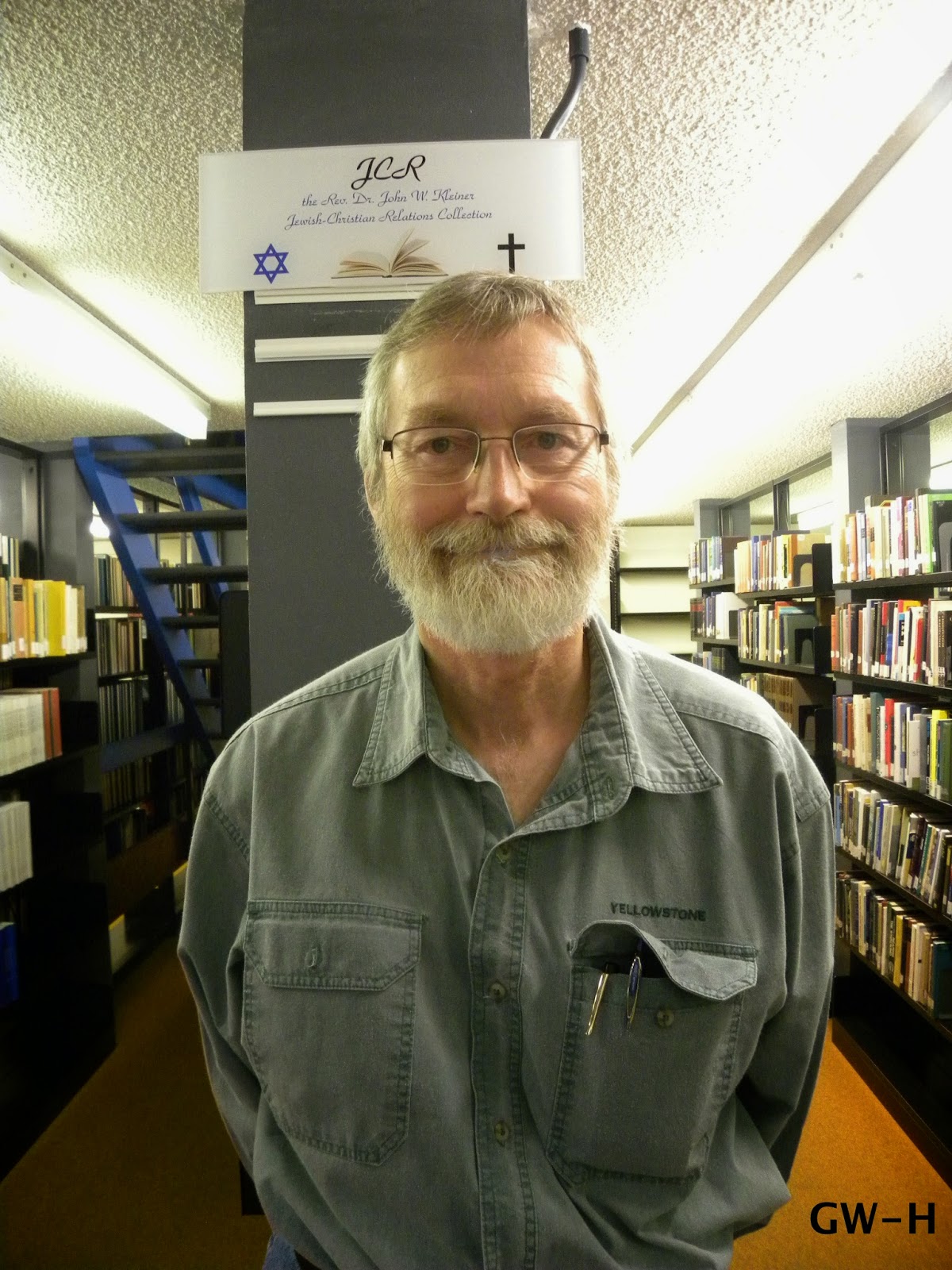
Dedication of the Rev. Dr. John W. Kleiner Jewish-Christian Relations Collection

Yours Truly in front of the Rev Dr John W Kleiner Jewish-Christian Relations Collection

Recently I was privileged to attend the Lutheran Theological Seminary Saskatoon Annual Study Conference. The keynote speaker was the Rev. Dr. Craig Van Gelder III, who presented three lectures on the theme: "A Changing Church in a Changing World: Discerning the Spirit's Leading in the 21st Century." A highlight for me was the dedication of the Rev. Dr. John W. Kleiner's Jewish-Christian Relations Collection in the LTS library. Dr. Kleiner was one of my professors at LTS. 

Saturday, February 7, 2015

Ancient tablets reveal life of Jews in Nebuchadnezzar's Babylon

(Reuters) - A new exhibition of ancient clay tablets discovered in modern-day Iraq is shedding light for the first time on the daily life of Jews exiled to Babylon some 2,500 years ago.
The exhibition is based on more than 100 cuneiform tablets, each no bigger than an adult's palm, that detail transactions and contracts between Judeans driven from, or convinced to move from, Jerusalem by King Nebuchadnezzar around 600 BC.

Archaeologists got their first chance to see the tablets -- acquired by a wealthy London-based Israeli collector -- barely two years ago. They were blown away. Watch a short video clip and read the whole thing here.

Friday, April 29, 2011

Yom HaShoah - Holocaust Remembrance Day - Continued

[ INTRODUCTORY NOTE TO READERS: The following, Spirit-inspired letter was sent to me by my friend Fritz Voll, who has devoted many years to Jewish-Christian Relations, as well as an active member on the Canadian Council of Christians and Jews, and was the founding webmaster of the excellent cyber library and reference website, Jewish-Christian Relations. This website is, in my humble opinion, the best of  its kind in the world. Fritz has kindly given me permission to publish his letter here on my blog, many thanks Fritz, and blessings always!  Dim Lamp ]

Dear Garth,

Thank you very much for writing and pointing me to your blog. I had just taken a break from reading the book of Sidney Cyngiser about his Holocaust ordeal, when I read your mail and looked up your blog. I started to write something directly into the Web page but then thought, this is getting too long, so I decided to send my comment to you as email. You can perhaps then put whatever you want into the comment box, the whole thing or just a few sentences. You can of course also make page of it as a letter from a friend of yours, whatever you decide will be fine with me.

Here it is:

---------------------------------

It is Friday, the 29th of April, two days before Yom HaShoa, Holocaust Remembrance Day, and I am reading the book that my dear Jewish friend, Sidney Cyngiser has just published. He and his wife Bronia are Holocaust survivors whom I met in Calgary, AB, about 27 years ago. He is six years older than I, and was as young teenager together with his family forcefully taken by German soldiers from their home in Radom, Poland. His mother and siblings were sent to the gas chambers in Treblinka and murdered, while he and his father were chosen ('selected' they called it) to do slave labour at only about 17 years of age. He survived the hunger, cruelty of the guards and hard labour in more than one concentration camp and in the end the death-march from the east of Germany to Stuttgart-Vaihingen in the west. Diseased and as a skeleton of skin and bones he was freed by the American army and received prolonged medical care, only to see other survivors die around him with no chance to survive their survival. In hospital he had met Bronia, a child survivor of the camps.

I am reading the book as a German who came to Canada and to the City of Calgary rather late in life with my wife and three teenagers. I was 46 then and at age 53 I met Sidney at a Holocaust Symposium for high school students that I attended as a German in order to answer questions about the new democratic Germany. I also met adult children of survivors -- they were called the "Second Generation." Some of them encouraged me to stand with them as witness of what had happened, they considered me "Second Generation" as well, being a German of the generation after that of the perpetrators of the Shoah, the Holocaust.

When I first met Sidney, he accepted me with open arms and an open heart. After having had studied the Holocaust already in my youth soon after WW II, I had expected to be shunned by survivors. I had never before met one before in Germany and here in Calgary were about 70, all integrated in a vibrant Jewish community. After they had heard my views on the Shoah and my deep sorrow over what had been done and had perceived my utter condemnation of what was done in our name as Germans, some begun to trust me, and one of the first and most remarkable persons to do so was Sidney Cyngiser. We sat together and talked. He told me some of his experiences of German SS-guards that are so horrific that he would not relate them to the students. Sometimes I wept with him when we talked over the phone about the unspeakable cruelty of ordinary Germans who actually believed what their Nazi masters had told them about the Jews and enthusiastically or just in blind obedience debased, tortured and murdered the people of God's covenant, the people of the Christian Bible, whom Christians, for centuries, had considered only in a "theology of contempt" (Jules Isaac), who for Christians had been replaced by the church, who were expelled from 'Christian' countries and blamed for all the evils in the world for centuries.

In meeting these survivors I had to face recent German history again, but now in experiences of people like myself. Since that time the Jewish Shoah is present to me on every day of my life. When I hear the rumors people are spreading about other people -- I know where it can lead to. When I am in physical pain due to an illness, I think of the suffering of God's people Israel before they had a country of their own. When I hear and read about the denial of the Holocaust, I can sense how the survivors and their children are again hurting, because after all their unspeakable suffering that left deep wounds and scars in their bodies and souls, they are tortured again as liars. And then there are those, even 'Christians,' who blame the Jews for their fate, as people blame the raped woman for her ordeal. Every day new wounds are thoughtlessly or violently punched into the souls of the Jewish people in conversations, on the Internet and by badmouthing Israel, as if the young nation was not a nation of Jewish individuals, many of them survivors of the Holocaust, others of anti-Semitism in diverse countries who finally found a home, after no one wanted them.

Recently I translated a small German Anthology of Citations. Words by historians, philosophers, theologians and even perpetrators and survivors of the Holocaust that span the history of Germany from the outgoing 19th through the 20th century. A chorus of voices that can make us watchful for the early signs of discrimination against groups of people different to ourselves but no less human than we are.

The book that I am reading:

Sidney Cyngiser: Surviving the Survival: The Life Stories of Holocaust Survivors Sidney and Bronia Cyngiser. 2010, 484 pages. ISBN 978-0-9811715-0-0 . Contact: Sidney Cyngiser, 119 Canterville Rd SW, Calgary, AB T2W 4R2 Tel: (403) 238-3788)


The small book I translated from the German:

Konrad Goerg, We are what we Remember: Germans, Two Generations after Auschwitz. Voices to Remind Us.


[Kindle Edition]


[Paperback]


------------------------------------

I don't know if I told you about the Holocaust Education Week that takes place in Toronto in November of each year, organized by the Jewish community and the Christian-Jewish Dialogue of Toronto. They had 100 different events during the week last November in libraries, schools, churches and synagogues (not in a mosque). I attended an event in Markham at a Baptist church, whose senior pastor has become a good friend since, and at a synagogue, where I heard Prof. Harold Troper speak, one of the writers of the book "None is too Many."

Thanks again and every blessing to you and yours.

Fritz

Yom HaShoah - Holocaust Remembrance Day

Yom HaShoah – Holocaust Remembrance Day

This Sunday, May 1, 2011, marks Yom HaShoah—Holocaust Remembrance Day. It is observed on the Hebrew calendar date of Nissan 27th. The purpose of this day is to remember the lives of some six million Jews who were murdered during the Holocaust, and to learn from the experiences and testimony of Holocaust Survivors. The day was chosen by Israel’s Knesset in 1951, and is observed by most Jews around the world. On this day, the Jewish mourning prayer is prayed, which you can see here.
   One of the most helpful resources I have found—I do not know if it is still in print— for Jews and Christians to observe Yom HaShoah together is Eugene J. Fisher & Leon Klenicki, An Interreligious Holocaust Memorial Service: From Desolation to Hope (New York & Chicago: Stimulus Foundation & Liturgy Training Publications, my copy was revised in 1990).
   The following website—although some items may need to be updated—is an informative resource for further information on the Holocaust: The Sarah and Chaim Neuberger Holocaust Education Centre.
   For a first-hand account of a Holocaust Survivor, I highly recommend the books of Nobel Peace Prize winner, author, scholar, teacher and humanitarian, Elie Wiesel. You can also visit his website here.
   Online articles on Yom Hashoah are also available at the Jewish-Christian Relations website here.
   I encourage Christian readers to attend the Yom HaShoah Service in your community, if there is one. Contact your local synagogue for the pertinent information.

Wednesday, March 2, 2011

The pope's new book

According to breaking news at the Simon Wiesenthal Center, the pope, in his new book Jesus of Nazareth-Part II, absolves Jewish collective guilt for the death of Jesus. I think Christians (not only Roman Catholics) have been slow in absolving the Jews. Had Christians done so centuries ago, history may have been much different, a lot less antisemitism. It is, nonetheless, better late than never, especially in light of the growing antisemitism in many countries. It is too early to know how the church and the world shall respond to the pope's latest gesture, we'll have to wait and see. You can read the news release from SWC here.